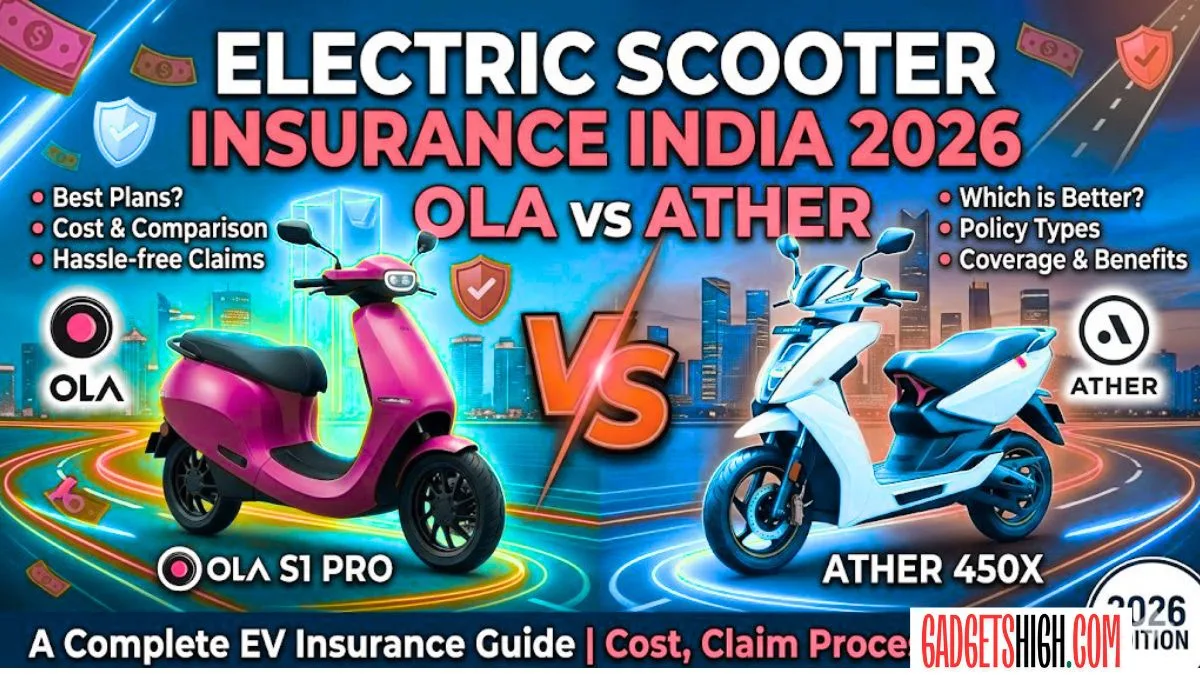
Looking for the best electric scooter insurance plans in India 2026? Compare EV insurance costs, claim process & buying guides. Updated for 2026.

BEST ELECTRIC SCOOTER INSURANCE PLANS
India’s electric scooter revolution is no longer a future promise it is happening right now, on every road, in every city. From Ola Electric and Ather to TVS iQube and Bajaj Chetak, millions of Indians are switching to cleaner, smarter mobility.
But here is the thing most new EV owners overlook: buying the scooter is only half the story. Insuring it properly is where smart ownership truly begins.
Electric scooter insurance in India is not just a legal checkbox. It is a financial safety net for a vehicle whose battery alone can cost anywhere between Rs. 70,000 and 100,000 to replace. In 2026, with the EV market
Growing faster than ever, understanding which insurance plan works best for your specific scooter and why—is more important than ever.
This guide covers everything: the best plans available today, actual premium costs, a head-to-head comparison of Ola Electric vs Ather insurance, a step-by-step claim process, and honest answers to the
questions every EV owner is asking.
WHY ELECTRIC SCOOTER INSURANCE IS DIFFERENT FROM REGULAR BIKE INSURANCE
Before diving into plans and prices, let us understand why insuring an electric scooter is a different game altogether compared to a petrol bike.
Electric scooters have high-value components especially the lithium-ion battery pack that standard bike insurance policies were never designed to cover. A minor accident that might cost Rs. 5,000 to repair on a petrol scooter can spiral into a Rs. 50,000+ repair job on an EV if the battery management system or motor controller is damaged.
Additionally, EV repair infrastructure is still developing in India. Fewer authorized service centers mean longer turnaround times, higher labor costs, and occasionally, imported parts. Insurers factor this risk into their pricing, which is why Own Damage (OD) premiums for EVs are typically higher than for equivalent petrol vehicles.
The good news? IRDAI has approved a 15% discount on third-party premiums for electric vehicles, recognising that EVs are statistically lower-risk on emissions and, increasingly, on accident frequency too.
TYPES OF ELECTRIC SCOOTER INSURANCE IN INDIA
1. THIRD-PARTY (TP) INSURANCE
Mandatory under the Motor Vehicles Act, 1988, for all registered electric scooters above 250 W and 25 km/h top speed. It covers damage or injury caused to a third party in an accident. It does NOT cover your own scooter. For new EVs in 2026, a 5-year TP policy is bundled at purchase. The IRDAI-fixed TP rate for EVs with motors between 7kW and 16kW (which includes Ola S1 Pro and Ather 450X) is approximately Rs. 1,014 to 1,100 per year.
2. OWN DAMAGE (OD) INSURANCE
Covers your scooter against accidents, fire, theft, and natural disasters. This is where you get to choose your insurer and negotiate. The OD premium is calculated based on the scooter’s IDV (Insured Declared Value), your city, your claim history (NCB), and any add-ons.
3. COMPREHENSIVE INSURANCE
The best choice for EV owners. It combines TP + OD cover in one policy and allows you to add critical riders like battery protection, zero depreciation, and roadside assistance. For a new Ola S1 Pro or Ather 450X, a 1-year OD + 5-year TP bundled comprehensive policy typically costs between Rs. 7,300 and 7,800 in 2026.
EV INSURANCE COST IN INDIA 2026—WHAT ARE YOU ACTUALLY PAYING?

Let us break down the real numbers for popular electric scooters in India:
| Scooter | Ex-Showroom Price | TP (Annual) | Comprehensive Insurance |
|---|---|---|---|
| Ola S1 Pro+ | Rs. 154,999 | Rs. 1,100 | 7,300 – 7,800 |
| Ola S1 X | Rs. 84,999 | Rs. 1,014 | 4,500 – 5,200 |
| Ather 450X | Rs. 145,000* | Rs. 1,100 | 6,800 – 7,400 |
| Ather 450 Apex | Rs. 185,000 | Rs. 1,100 | 8,000 – 9,500 |
| Ather Rizta | Rs. 75,999 | Rs. 1,014 | 4,200 – 4,800 |
| TVS iQube | Rs. 126,000* | Rs. 1,014 | 5,500 – 6,200 |
| Bajaj Chetak | Rs. 120,000* | Rs. 1,014 | 5,200 – 5,900 |
(*Approximate ex-showroom price, varies by variant and city, 2026)
Note: GST at 18% is applicable on both TP and OD premiums. Prices above are base estimates; actual premiums vary by insurer, city RTO, and chosen add-ons.
KEY INSIGHT: The OD premium for Ola S1 Pro has seen a 12% “Performance Surcharge” in 2026, as insurers have noticed that higher torque EVs have a slightly higher urban accident frequency compared to lower-power models.
OLA ELECTRIC INSURANCE VS. ATHER INSURANCE—DETAILED COMPARISON
This is one of the most searched topics in EV insurance in India today, and for good reason. Both brands have distinct insurance personalities.
OLA ELECTRIC INSURANCE
Ola Electric’s hyper-integrated chassis design is its greatest strength and its biggest insurance challenge. The S1 series uses a monocoque-style frame where the battery, motor, and body panels are deeply integrated. While this makes the scooter feel premium, it creates a real problem during claims: even a minor frame bend often cannot be repaired—it triggers a full frame replacement, which can exceed 75% of the IDV, leading insurers to declare the scooter a “total loss” even after moderate accidents.
What this means practically: Ola owners face a higher chance of their scooter being “totalled” after what feels like a minor incident. This is why the Ola S1 Pro carries a higher OD premium in 2026.
Best insurance strategy for Ola owners:
– Always buy Zero Depreciation add-on.
– Invest in a Consumables Cover (for underbody protection)
– Ensure your policy specifically includes Battery Protection cover
– Choose an insurer with a wide cashless garage network in your city
ATHER INSURANCE
Ather Energy’s modular, precision-machined aluminum build is a very different story. Because Ather’s components are designed to be individually serviceable, minor claims tend to result in part-level replacements rather than full assembly write-offs. A damaged panel stays a panel—not a reason to total the scooter. This leads to cheaper minor claims and more predictable repair costs.
Ather also has a tightly controlled service network with standardized labor rates, which keeps repair estimates more consistent. Insurers find Ather vehicles easier to assess, which is reflected in marginally lower OD premiums compared to equivalent Ola models.
Best insurance strategy for Ather owners:
– A comprehensive policy is strongly recommended (battery costs ₹70K+)
– Add Return to Invoice cover if your scooter is financed
– Zero Depreciation is worth it for the first two years
– Consider Roadside Assistance Ather Grid charging points are growing but off-highway coverage is still limited
COMPARISON TABLE: OLA ELECTRIC vs ATHER INSURANCE (2026)

Prices are approximate and vary by city and variant.
MUST-HAVE ADD-ONS FOR ELECTRIC SCOOTER INSURANCE IN 2026
1. BATTERY PROTECTION COVER
The single most important add-on for any EV owner. Standard policies often exclude battery damage from specific causes. This add-on covers battery damage due to accidents, electrical faults, and in some policies, even degradation beyond a threshold. Cost: Rs. 500–Rs. 1,200/year extra. Value: Potentially Rs. 70,000+ in savings.
2. ZERO DEPRECIATION COVER
Without this, your insurer deducts depreciation on replaced parts during a claim. For EV-specific components (body panels, electrical systems), depreciation can be steep. Zero Dep removes this deduction.
Cost: Rs. 800–1,500/year extra.
3. ROADSIDE ASSISTANCE (RSA)
Unlike petrol bikes, you cannot push-start a dead electric scooter. RSA provides 24/7 emergency towing or on-spot assistance if your battery runs out or a technical fault occurs mid-journey.
4. RETURN TO INVOICE (RTI)
If your scooter is stolen or declared a total loss, RTI pays you the original invoice value instead of the depreciated IDV. Essential if your scooter is financed or less than 2 years old.
5. NO CLAIM BONUS PROTECTION
Preserves your NCB discount (up to 50% after 5 claim-free years) even if you raise one claim in a policy year. Ideal for daily riders.
ELECTRIC BIKE INSURANCE CLAIM PROCESS — STEP BY STEP
Filing a claim for your electric scooter does not need to be stressful. Here is exactly how to do it right:
STEP 1: SECURE THE SCENE
After an accident or incident, ensure your safety first. Do not move the scooter if there is significant damage. Call emergency services if needed.
STEP 2: INFORM YOUR INSURER IMMEDIATELY
Most insurers require you to notify them within 24–48 hours of an incident. Call the toll-free helpline or use the insurer’s mobile app. Delay in intimation can be grounds for claim rejection.
STEP 3: FILE AN FIR (IF REQUIRED)
For theft, major accidents involving third parties, or significant damage to one’s own property, an FIR at the local police station is mandatory before filing the claim.
STEP 4: DOCUMENT EVERYTHING
Take clear photographs of the damaged scooter from multiple angles. Photograph the accident site, any other vehicles involved, and visible road conditions. This is your evidence.
STEP 5: SURVEYOR INSPECTION
Your insurer will assign a surveyor (sometimes a video inspection for minor claims). The surveyor assesses the damage and prepares a repair estimate. For EV claims, specifically ask for a surveyor with EV experience — this matters for battery and motor assessments.
STEP 6: CASHLESS VS. REIMBURSEMENT
– Cashless Claim: Get your scooter repaired at a network garage. The insurer settles the bill directly with the garage.
– Reimbursement Claim: Get repairs done at any authorized EV service center, pay the bill, and submit all invoices for reimbursement. Cashless is usually faster and has less paperwork.
STEP 7: DOCUMENTS TO SUBMIT
– Copy of insurance policy
– RC (Registration Certificate) of the scooter
– Valid driver’s license
– FIR copy (if applicable)
– Repair estimate / invoices
– Photographs of damage
– Claim form (duly signed)
– Bank account details (for reimbursement)
STEP 8: CLAIM SETTLEMENT
Once the insurer approves, settlement typically takes 7–15 working days for straightforward claims. Complex claims involving battery replacement or total loss assessments may take 20–30 days.
BUYING GUIDE: HOW TO CHOOSE THE RIGHT EV INSURANCE PLAN
Choosing the right insurance plan for your electric scooter comes down to five practical questions:
1. HOW MUCH IS YOUR SCOOTER WORTH?
Higher-value scooters (Rs. 1 lakh+) should always have comprehensive cover. The cost difference between TP-only and comprehensive is small compared to what you stand to lose in an uncovered accident.
2. DO YOU RIDE DAILY?
Daily riders face higher accident probability by sheer exposure. Go for comprehensive cover with Zero Dep and RSA. Occasional riders can consider TP + battery protection as a cost-effective middle ground.
3. IS YOUR SCOOTER FINANCED?
If you have a loan on your scooter, most lenders require comprehensive insurance anyway. Add RTI cover to protect your loan balance.
4. WHERE DO YOU RIDE?
Urban riders in dense cities (Mumbai, Delhi, and Bengaluru) face higher theft and accident risks. Suburban or smaller city riders may get away with a leaner policy.
5. WHO IS YOUR INSURER?
Compare claim settlement ratios before buying. Top insurers for EV two-wheelers in 2026 include ACKO General Insurance, HDFC ERGO, Bajaj Allianz, ICICI Lombard, and Bharti AXA — all offering strong cashless garage networks and dedicated EV claim teams.
PRO TIP: Always compare quotes on aggregator platforms like PolicyBazaar, InsuranceDekho, or Quickinsure. For the same scooter and coverage, you can often find a 15–20% premium difference between insurers.
PROS & CONS OF ELECTRIC SCOOTER INSURANCE
PROS:
Financial protection against battery damage (most expensive EV part)
Legal compliance—third-party insurance is mandatory
Peace of mind for daily urban commuting
IRDAI’s 15% TP discount makes EV insurance slightly cheaper than equivalent petrol bikes on the TP component
Add-ons like battery protection are specifically designed for EVs
Cashless claims at growing EV-authorised network garages
NCB rewards can bring premiums down by up to 50% over 5 years
CONS:
OD premiums are higher than petrol bikes due to expensive EV components
Battery replacement cost is enormous without specific battery cover
Surveyor expertise for EV damage varies widely—inexperienced surveyors may over-declare vehicles as total loss
EV-authorised cashless garages are still limited in Tier 2 & 3 cities
Integrated chassis designs (like Ola S1 series) increase total loss risk
Comprehensive premiums rise with performance surcharges on high-torque
models
Claim processing for battery-related damage can be slower due to the
need for specialist EV assessment
10 FREQUENTLY ASKED QUESTIONS (FAQs) — EV INSURANCE INDIA 2026
Q1: IS INSURANCE MANDATORY FOR ELECTRIC SCOOTERS IN INDIA?
A: Yes — for any electric scooter with motor power above 250W and a top speed exceeding 25 km/h, third-party insurance is mandatory under the Motor Vehicles Act. Low-speed scooters below these thresholds are
currently exempt, but having at least TP cover is strongly advisable for any on-road vehicle.
Q2: DOES ELECTRIC SCOOTER INSURANCE COVER BATTERY DAMAGE?
A: Not automatically. Standard comprehensive policies often treat battery damage on a case-by-case basis. To be fully protected, you must add a dedicated battery protection add-on to your policy. Given that battery
Replacement costs Rs. 70,000 to 100,000; this add-on is a must-have.
Q3: WHY IS EV INSURANCE MORE EXPENSIVE THAN PETROL BIKE INSURANCE?
A: The Own Damage (OD) premium is higher because EVs have expensive, specialized components especially the battery and motor controller that cost significantly more to repair or replace than equivalent
petrol bike parts. However, the TP component is actually cheaper for EVs, with IRDAI offering a 15% discount.
Q4: WHAT IS IDV IN EV INSURANCE, AND HOW DOES IT AFFECT MY PREMIUM?
A: IDV (Insured Declared Value) is the current market value of your scooter essentially the maximum amount your insurer will pay in case of total loss or theft. For EVs, IDV is calculated on the total vehicle value, but battery health may be assessed separately for replacement claims. A higher IDV means a higher premium but better protection.
Q5: CAN I GET INSURANCE FOR MY OLA OR ATHER WITHOUT GOING TO A DEALERSHIP?
A: Absolutely. You can buy or renew EV insurance entirely online through platforms like PolicyBazaar, InsuranceDekho, or ACKO or directly from insurer websites. Online purchase often costs 10–15% less than
dealership-bundled plans due to elimination of middlemen.
Q6: WHAT HAPPENS TO MY NO-CLAIM BONUS (NCB) IF I SWITCH INSURERS?
A: Your NCB is tied to you as a policyholder, not to the insurer. When you switch insurers at renewal, you can transfer your NCB by providing the NCB certificate from your previous insurer. NCB can reduce your OD premium by up to 50% after five consecutive claim-free years.
Q7: DOES EV INSURANCE COVER FIRE OR EXPLOSION OF THE BATTERY?
A: This varies by insurer and policy wording. Comprehensive policies generally cover fire damage, but some may have exclusions for “spontaneous combustion” or “manufacturing defects.” Read your policy document carefully and add a specific battery protection rider if in doubt. Always check for the specific wording around “electrical damage” and “short circuit.”
Q8: IS ROADSIDE ASSISTANCE WORTH BUYING FOR AN ELECTRIC SCOOTER?
A: Yes — strongly recommended. Unlike petrol bikes, a battery-depleted electric scooter cannot be rescued by borrowing fuel from a passer-by. RSA provides emergency towing, on-spot technical assistance, and in
some plans, temporary replacement transport. For daily commuters, the annual cost of Rs. 300–700 for RSA is excellent value for money.
Q9: DOES MY EV WARRANTY REPLACE THE NEED FOR COMPREHENSIVE INSURANCE?
A: No — these are completely different protections. The manufacturer’s warranty covers factory defects and component failures under normal use. It does NOT cover accident damage, theft, flood damage, or third-party liability. Insurance and warranty work alongside each other; you need both for complete protection of your EV investment.
FINAL VERDICT
Electric scooter insurance in India in 2026 is not a formality it is an essential part of owning an EV that costs anywhere from Rs. 75,000 to 185,000 and carries a battery worth Rs. 70,000 or more on its own.
For MOST ELECTRIC SCOOTER OWNERS, the ideal insurance combination is:
Comprehensive Policy (OD + 5-year TP bundled)
Battery Protection Add-on (non-negotiable)
Zero Depreciation Cover (for first 3 years at least)
Roadside Assistance (for daily commuters)
For OLA ELECTRIC OWNERS specifically: prioritise Zero Depreciation and Consumables Cover due to the integrated chassis risk of premature total loss declarations.
For ATHER OWNERS: the modular build works in your favor focus on battery protection and RSA, and compare OD premiums across at least three insurers before buying.
The broader lesson? Spend 30 minutes comparing insurance plans with the same seriousness you spent comparing scooter models. The money you save or protect will be worth every second.
Rajendra Parmar is the founder and editor of GadgetsHigh, a technology-focused platform covering the latest updates, reviews, comparisons, and buying guides for smartphones, smart TVs, laptops, smartwatches, gadgets, and electric vehicles (EVs).
With a strong passion for technology and consumer electronics, Rajendra regularly researches and publishes content on emerging tech trends, new product launches, EV developments, and in-depth gadget comparisons. His goal is to provide accurate, practical, and easy-to-understand information that helps readers make informed purchasing decisions.
At Gadgets High, he focuses on delivering reliable coverage of:
- 📱 Smartphones → — Budget to mid-range, best phones for every pocket
- 💻 Laptops → — Student laptops, office workhorses, and light gaming machines
- 📺 Smart TVs → — Tested for real picture quality and smart OS performance
- ⌚ Smartwatches → — We separate real features from marketing gimmicks
- 🎧 Smart Gadgets → — TWS earbuds and neckbands across all price points
- 🛠️ AI & Online Tools → Helpful AI tools, productivity apps, and digital solutions for everyday users
- ⚡ Auto & EVs → Electric scooters, bikes, and cars explained simply.
Rajendra founded Gadgets High with the vision of making technology information accessible to everyone through well-researched, reader-friendly content.
Social Connect with Rajendra Parmar
YouTube | LinkedIn | Facebook |
Contact: Email: Raj.parmar3399@gmail.com
The information published on Gadgets High is researched from official sources, product announcements, industry updates, and hands-on analysis wherever applicable. Readers are encouraged to verify product specifications and pricing from official websites before making purchase decisions.
