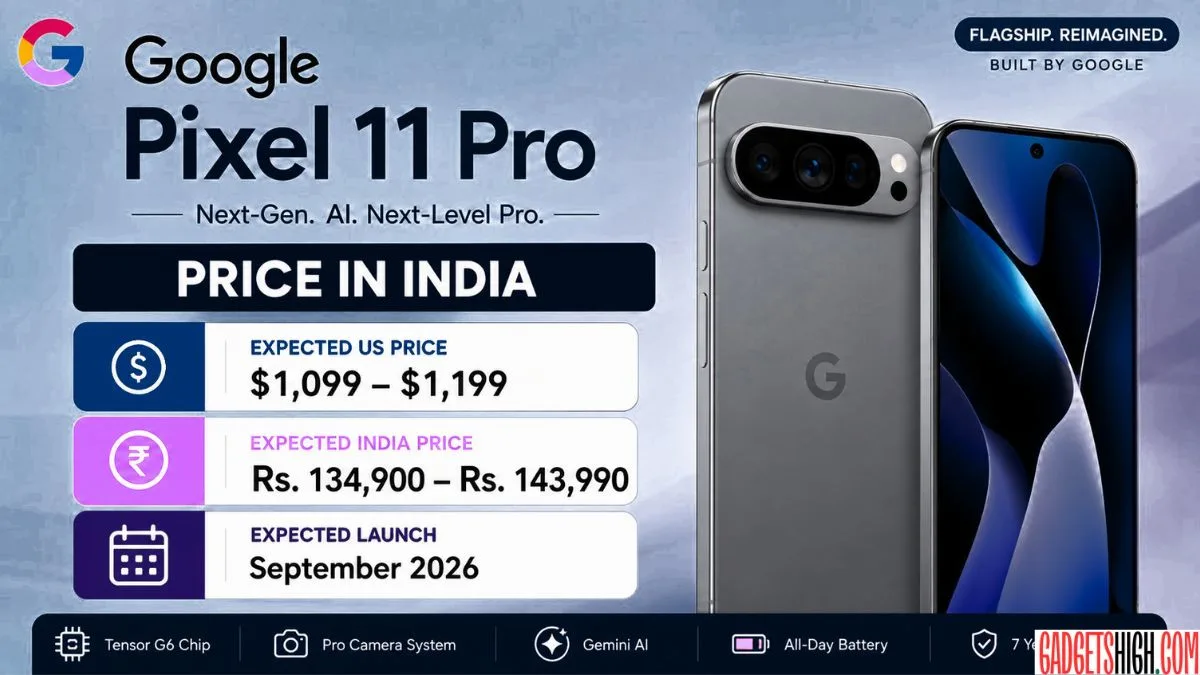
Google Pixel 11 Pro 2026: Specs, price, launch date, camera, battery, AI features, iPhone 18 Pro comparison, pros & cons, and buying guide.

Google Pixel 11 Pro
2026 is shaping up to be one of the most exciting years in smartphone history—and right at the center of that excitement is the Google Pixel 11 Pro. Google’s flagship has never been just another Android phone.
Pixel 11 pro has always been the phone that puts pure software intelligence, computational photography, and the raw power
of Google’s AI ecosystem into a single sleek device. And this year, the Pixel 11 series promises to deliver the most meaningful hardware leap in years.
If you have been sitting on a Pixel 9 Pro or an older Android device, this is the moment you have probably been waiting for. And if you are an iPhone user wondering whether to switch, the Pixel 11 Pro vs iPhone 18 Pro conversation is genuinely one of the most interesting tech debates of 2026.
This article breaks down everything — from specs and confirmed leaks to a full comparison table, buying guide, honest pros and cons, ten frequently asked questions, and a final verdict. Let’s dig in.
Google Pixel 11 Pro price India
| Feature | Details |
|---|
| Expected US Price | $1,099 – $1,199 |
| Expected India Price | Rs. 134,900 – Rs. 143,990 |
| Expected Launch | September 2026 |
GOOGLE PIXEL 11 SERIES — WHAT’S IN THE LINEUP?
Google is expected to launch four devices in the Pixel 11 family, all unveiled at a “Made by Google” hardware event confirmed for mid-to-late August 2026:
| Model | Codename | Expected Launch |
|---|
| Google Pixel 11 | Cubs | Expected 2026 |
| Google Pixel 11 Pro | Grizzly | Expected 2026 |
| Google Pixel 11 Pro XL | Kodiak | Expected 2026 |
| Google Pixel 11 Pro Fold | Yogi | Expected October 2026 |
Google has firmly established a summer launch rhythm after moving away from October releases.
The Pixel 9 launched in August 2024, the Pixel 10 in August 2025, and the Pixel 11 is following the same playbook, giving Google a full month of media attention before Apple’s September iPhone cycle begins.
Google Pixel 11 Pro specifications (LEAKED / EXPECTED)

Chipset:
Google Tensor G6, built on TSMC’s cutting-edge 2-nanometer (N2) process. This is the first smartphone chip at 2nm — the most advanced fabrication technology available in 2026.
The G6 features a unique 7-core CPU layout (instead of the usual 8 cores): one ARM C1-Ultra core at 4.11 GHz, four ARM C1-Pro cores at 3.38 GHz, and two ARM C1-Pro cores at 2.65 GHz. Google is deliberately optimizing for sustained AI performance and thermal efficiency rather than peak benchmark scores.
Modem:
MediaTek M90 — a major change after six years of Samsung Exynos modems. This switch is expected to deliver significantly better 5G reliability, faster recovery after signal drops, and improved battery life during
heavy mobile data use. Satellite connectivity support is also expected.
Display:
6.3-inch LTPO OLED panel (Pro model) with an adaptive 1 to 120 Hz (possibly up to 144 Hz) refresh rate. Peak brightness is expected to reach 2,450 nits.
Notably, the Pixel 11 Pro is expected to be among the first phones to use Samsung’s new M16 display material—more power-efficient, brighter outdoors, and more color accurate than the M14 panels used in the Pixel 10 Pro and Galaxy S26.
Pixel 11 Pro XL: 6.8-inch OLED, same specs as above.
RAM & Storage:
Leaked specs suggest 12 GB or 16 GB RAM options. This is a potential step down from the Pixel 10 Pro’s flat 16 GB, which Google may do to keep prices competitive against rising memory chip costs. Storage is expected to start at 256 GB, with 512 GB and 1 TB options—the 128 GB tier appears to be dropped entirely.
Camera System:
The Pixel 11 Pro gets all-new main and telephoto sensors (codenamed “Bastet” and “Barghest”). Leaked details point to a 50 MP main sensor, with rumors of a 64 MP periscope telephoto with up to 10x optical zoom (unconfirmed).
New ultra-low-light video recording capabilities are expected to allow sharp video capture in near-total darkness (5–10 lux). AI-assisted video features are a major focus, with AI tools from photos now extending into video editing via Google Photos and YouTube.
Pixel Glow (New Feature):
The infrared temperature sensor from the Pixel 8 Pro era is gone. In its place, Pixel 11 Pro and Pro XL get “Pixel Glow”—a full-color RGB LED array built into the camera bar.
Think of it as Google’s more refined, professional answer to Nothing Phone’s Glyph Interface. It enables colorful always-on notifications, indicators, and display widgets.
Design:
Thinner bezels for a higher display-to-body ratio. The camera bar loses its aluminum accent, reverting to an all-glass blacked-out visor reminiscent of the Pixel 6’s aesthetic but with modern refinements.
The overall form factor remains similar to the Pixel 10 Pro, meaning design upgrades are evolutionary rather than revolutionary. Under-display face unlock (Project Toscana) has reportedly been pushed to the Pixel 12.
Battery:
| Feature | Details |
|---|---|
| Pixel 11 Pro Battery | Approximately 4,707 mAh |
| Pixel 11 Pro XL Battery | Approximately 5,200 mAh |
| Wired Charging Speed | Expected 45 W (improved from earlier generations) |
| Wireless Charging | 25 W via Pixelsnap (Google’s MagSafe equivalent) |
| Removable Battery | Rumored, but not confirmed |
Operating System:
Android 17, with deep Gemini AI integration (Gemini Nano 3 on-device), real-time translation, AI photo and video editing, and enhanced personalization via Google’s ecosystem.
Expected Price (US):
| Model | Expected US Price | Expected India Price |
|---|
| Google Pixel 11 | ~$799 | — |
| Google Pixel 11 Pro | ~$999 | Rs. 1,03,999 – Rs. 1,19,999 |
| Google Pixel 11 Pro XL | ~$1,249 | — |
| Google Pixel 11 Pro Fold | ~$1,699 – $1,999 | — |
GOOGLE PIXEL 11 PRO — PROS & CONS
PROS:
✓ World’s first 2nm chip in a smartphone (Tensor G6 on TSMC N2)
✓ New MediaTek modem finally fixes Pixel’s long-standing connectivity issues
✓ M16 OLED display — among the brightest and most efficient panels in 2026
✓ Pixel Glow — a genuinely useful and distinctive design feature
✓ Deepest AI integration of any Android phone (Gemini Nano 3 on-device)
✓ Upgraded ultra-low-light video capabilities
✓ All-new camera sensors for improved telephoto and main photography
✓ 7 years of OS and security updates guaranteed
✓ Cleaner Android experience without bloatware
✓ Expected to be priced more competitively than iPhone 18 Pro
CONS:
✗ Under-display face unlock pushed to 2027 (Pixel 12)
✗ Potential RAM reduction to 12 GB (from 16 GB) may affect long-term AI
✗ Tensor G6 GPU uses older architecture — not ideal for heavy mobile gaming
✗ Design is evolutionary, not a major visual overhaul
✗ Battery capacity is smaller than competitors at similar price points
✗ Global availability (including India) typically 2–4 weeks after US launch
✗ Removable battery remains unconfirmed and unlikely
APPLE iPHONE 18 PRO — KEY EXPECTED SPECS (FOR COMPARISON)
Google Pixel 11 (Base Model):
Best for users who want a solid AI-powered Android experience without paying flagship Pro prices. You get the same Tensor G6 chip and Android 17 integration, a 50 MP main camera, and a 120 Hz OLED display.
You do miss Pixel Glow, the upgraded telephoto, and the brighter Pro display. Expected at ~$799 — a smart buy for most people.
Google Pixel 11 Pro:
This is the sweet spot of the lineup. You get everything — Pixel Glow, new camera sensors, the M16 display, and the full Tensor G6 AI suite — in the more pocketable 6.3-inch form factor. At ~$999, it competes directly with the iPhone 18 Pro and wins on AI depth and price.
Google Pixel 11 Pro XL:
If battery life and screen real estate are your top priorities, the Pro XL is your phone. The 6.8-inch M16 panel and larger ~5,200 mAh battery make it a true powerhouse.
At ~$1,249, it’s slightly cheaper than the iPhone 18 Pro Max (~$1,299). This is the one to buy if you are a heavy user or content creator.
Google Pixel 11 Pro Fold:
For foldable fans, the Pixel 11 Pro Fold arrives in October 2026 at ~$1,699–$1,999. At 4.8 mm thin when unfolded, it is expected to be the slimmest foldable of 2026. The 8-inch inner screen and 6.4-inch outer screen make it a genuine productivity device.
BUYING GUIDE — WHO SHOULD BUY THE GOOGLE PIXEL 11 PRO?
BUY the Pixel 11 Pro IF:
• You are upgrading from a Pixel 9 Pro or older, and want a major leap in both chipset efficiency and camera capability.
• You love photography, especially in low light and video. The Pixel series has consistently led in computational photography, and the Pixel 11 Pro’s new camera sensors plus AI video tools make it the best camera Android phone of 2026 for most users.
• You want the deepest AI integration available. Google’s Gemini Nano 3 runs entirely on-device, meaning features like real-time translation, AI photo editing, and smart replies work even without internet.
• You care about software longevity. Google guarantees 7 years of OS and security updates — better than nearly any Android competitor.
• You prefer a more competitive price than the iPhone 18 Pro. At ~$999 vs the iPhone’s ~$1,099, you save money while getting a genuinely impressive flagship.
• You are in the Google ecosystem (Gmail, Google Photos, YouTube, Google TV) and want everything tightly integrated.
SKIP the Pixel 11 Pro IF:
• You are a mobile gamer. The Tensor G6’s older GPU architecture means it will not keep up with Snapdragon 8 Gen 4 or A20 Pro for graphics.
• You are already on a Pixel 10 Pro. The design changes are minimal and the performance gap does not justify the cost of upgrading one year in.
• You are fully invested in the Apple ecosystem (iPhone, Mac, iPad, Apple Watch). In that case, the iPhone 18 Pro is the better choice for seamless cross-device experience.
• You want under-display face unlock.
Apple iPhone 18 Pro vs. Google Pixel 11 Pro leak; Google Pixel 11 series specifications and features are currently expected/rumored.
FREQUENTLY ASKED QUESTIONS (FAQs)
Q1. When will the Google Pixel 11 Pro launch officially?
A: Google is widely expected to announce the Pixel 11 Pro at a “Made by Google” hardware event in mid-to-late August 2026. Invites are expected in late June or July.
Pre-orders should open on announcement day, with shipping starting by end of August or early September 2026. The Pixel 11 Pro Fold follows separately in October 2026.
Q2. What is the expected price of the Google Pixel 11 Pro in India?
A: Based on current leaks and historical pricing trends, the Pixel 11 Pro is expected to be priced between Rs. 103,999 and Rs. 119,999 in India.
This would make it significantly more affordable than the iPhone 18 Pro which is expected at Rs. 134,900 to Rs. 143,990.
Q3. What is the Tensor G6 chip and how does it differ from the Tensor G5?
A: The Tensor G6 is Google’s in-house chipset built on TSMC’s 2-nanometer process — a generation ahead of the Tensor G5 (which used 3nm).
It has a unique 7-core CPU with a top clock speed of 4.11 GHz, a much larger NPU for on-device AI tasks, and now uses a MediaTek M90 modem instead of the Samsung Exynos modems that had plagued older Pixels with connectivity and battery drain issues.
Q4. What is “Pixel Glow” and is it just a gimmick?
A: Pixel Glow is Google’s new RGB LED light array built into the camera bar of the Pixel 11 Pro and Pro XL. It replaces the infrared temperature sensor from the Pixel 8 Pro—a feature that most users rarely used.
Pixel Glow enables colorful notification lights, charging indicators, and ambient display widgets. Whether it’s a gimmick depends on usage: for minimalists, it is an aesthetic feature; for power users who miss LED notification lights, it is genuinely useful.
Q5. Is the Google Pixel 11 Pro better than the iPhone 18 Pro for cameras?
A: It depends on what you shoot. The Pixel 11 Pro leads in computational photography, low-light stills, and AI-assisted editing—where Google’s software processing has historically been the best in the industry.
The iPhone 18 Pro, with its rumored variable aperture (f/1.4 to f/2.0) on the main sensor, is expected to be better for video, especially 4K/8K professional recording. If you are a photographer, Pixel wins. If you are a videographer or creator, iPhone may edge ahead.
Q6. Does the Pixel 11 Pro have Face Unlock?
A: Not in the traditional secure sense. Google was working on under-display face scanning (Project Toscana), but it has reportedly been pushed to the Pixel 12 in 2027. The Pixel 11 Pro will rely on the in-display fingerprint
sensor for biometric security.
Q7. Will the Pixel 11 Pro have a removable battery?
A: Very unlikely. While early leaks mentioned removable battery patents and interest from Google, most credible sources indicate this feature will not make it into the Pixel 11 series. It remains a possibility for future
generations.
Q8. How does the Pixel 11 Pro compare to the Samsung Galaxy S26 Ultra?
A: The Galaxy S26 Ultra remains the benchmark for Android performance (due to its Snapdragon chipset) and S Pen productivity.
However, the Pixel 11 Pro offers a cleaner Android experience, better AI software via Gemini, superior pure photography processing, and 7 years of OS updates vs Samsung’s 4–5. For daily AI-powered tasks and photography, Pixel wins. For gaming and power users who want maximum raw specs, the S26 Ultra wins.
Q9. What storage options will the Pixel 11 Pro offer?
A: The 128 GB base tier is expected to be discontinued. The Pixel 11 Pro will likely start at 256 GB, with 512 GB and 1 TB options available. There is no expandable microSD card slot.
Q10. Should I wait for the Pixel 11 Pro or buy the Pixel 10 Pro now?
A: If you are on a Pixel 9 Pro or older, wait. The Tensor G6’s 2nm architecture, new modem, Pixel Glow, and upgraded cameras represent a meaningful generational jump worth the wait.
If you are already on a Pixel 10 Pro, the changes are more incremental—you can upgrade or hold off until the Pixel 12 redesign in 2027, which is expected to be a much more dramatic overhaul.
FINAL VERDICT
The Google Pixel 11 Pro is shaping up to be Google’s most complete flagship yet—and arguably the most exciting Pixel since the Pixel 6 reset the brand’s identity in 2021.
The combination of the Tensor G6 on a 2nm process, a fixed MediaTek modem that finally solves the Pixel’s connectivity Achilles’ heel, the gorgeous M16 OLED panel, Pixel Glow, and best-in-class on-device AI makes this a compelling package.
At ~$999, it is also notably more affordable than the iPhone 18 Pro, which starts at ~$1,099 and rises steeply.
Where does the Pixel 11 Pro fall short? The lack of an under-display face unlock is a real disappointment in 2026—Apple is already doing it on the iPhone 18 Pro.
The potential RAM reduction to 12 GB raises long-term concerns about running increasingly AI-hungry features years from now. And gamers will want to look elsewhere, because the Tensor G6’s GPU is not designed to compete with Apple Silicon or Snapdragon in raw graphics tasks.
But here is the honest truth: for the vast majority of Android users—people who want a brilliant daily phone that takes stunning photos, handles AI tasks faster than any Android competitor, and receives software support for 7 full years—the Pixel 11 Pro is the Android phone to buy in 2026.
If you are in the Apple ecosystem and considering a switch, the Pixel 11 Pro is the most compelling case Google has made in years. And if you are already a Pixel fan? This is your upgrade.
RATING: 9.0 / 10
Best For: Photography enthusiasts, AI power users, long-term Android loyalists
Skip If: Mobile gamers, Pixel 10 Pro owners, Apple ecosystem users
DISCLAIMER: All specifications, prices, and features mentioned in this article are based on leaks, rumors, and credible supply-chain reports available as of June 2026.
Google has not officially announced or confirmed any details about the Pixel 11 series. Prices and specs are subject to change at launch. This article is for informational purposes only.
Rajendra Parmar is the founder and editor of GadgetsHigh, a technology-focused platform covering the latest updates, reviews, comparisons, and buying guides for smartphones, smart TVs, laptops, smartwatches, gadgets, and electric vehicles (EVs).
With a strong passion for technology and consumer electronics, Rajendra regularly researches and publishes content on emerging tech trends, new product launches, EV developments, and in-depth gadget comparisons. His goal is to provide accurate, practical, and easy-to-understand information that helps readers make informed purchasing decisions.
At Gadgets High, he focuses on delivering reliable coverage of:
- 📱 Smartphones → — Budget to mid-range, best phones for every pocket
- 💻 Laptops → — Student laptops, office workhorses, and light gaming machines
- 📺 Smart TVs → — Tested for real picture quality and smart OS performance
- ⌚ Smartwatches → — We separate real features from marketing gimmicks
- 🎧 Smart Gadgets → — TWS earbuds and neckbands across all price points
- 🛠️ AI & Online Tools → Helpful AI tools, productivity apps, and digital solutions for everyday users
- ⚡ Auto & EVs → Electric scooters, bikes, and cars explained simply.
Rajendra founded Gadgets High with the vision of making technology information accessible to everyone through well-researched, reader-friendly content.
Social Connect with Rajendra Parmar
YouTube | LinkedIn | Facebook |
Contact: Email: Raj.parmar3399@gmail.com
The information published on Gadgets High is researched from official sources, product announcements, industry updates, and hands-on analysis wherever applicable. Readers are encouraged to verify product specifications and pricing from official websites before making purchase decisions.
