Tata Tiago EV 2026: Is This Budget Electric Car Still Worth Buying?
A complete, honest breakdown of India’s most affordable EV—range, charging, features, running costs, and real-world ownership experience
If you have been watching fuel prices climb every few months and quietly wondering whether switching to an electric vehicle actually makes financial sense, the Tata Tiago EV deserves a serious look. It has been one of the most talked-about affordable EVs since its launch, and heading into 2026, it continues to hold its ground in a market that is getting more crowded and competitive by the month.
[Read more about Tata Sierra EV 2026: Price, Range, Features & Review.]
But does it still make sense to buy one today? That is the question we are going to answer thoroughly — no vague comparisons, no marketing fluff. Just a real, grounded look at what you actually get when you put down your money on a Tata Tiago EV in 2026.
Why the Tata Tiago EV Facelift Matters in 2026
India’s EV adoption story has been unfolding slowly but steadily. The bulk of the growth, however, has not come from luxury buyers or tech enthusiasts picking up premium EVs. It has come from everyday commuters—people who drive 40 to 80 kilometres a day for work, school runs, and weekend errands, and who are simply tired of paying upward of Rs. 100 at the fuel pump every few days.
The Tata Tiago EV was built specifically for this group of buyers. It is a small, sensible, practical hatchback that happens to run on electricity — and it does so at a price point that makes the switch financially justifiable for a wide range of Indian households.
In a segment where most EVs either cost too much, offer too little range, or feel like tech experiments rather than proper cars, the Tata Tiago EV has carved out a reputation as something genuinely usable. Three years into its life cycle, it has gathered real ownership data, a large user base across Indian cities, and a service network that actually functions.
That context matters a lot when you are making a buying decision.
Tata Tiago EV Price in India 2026

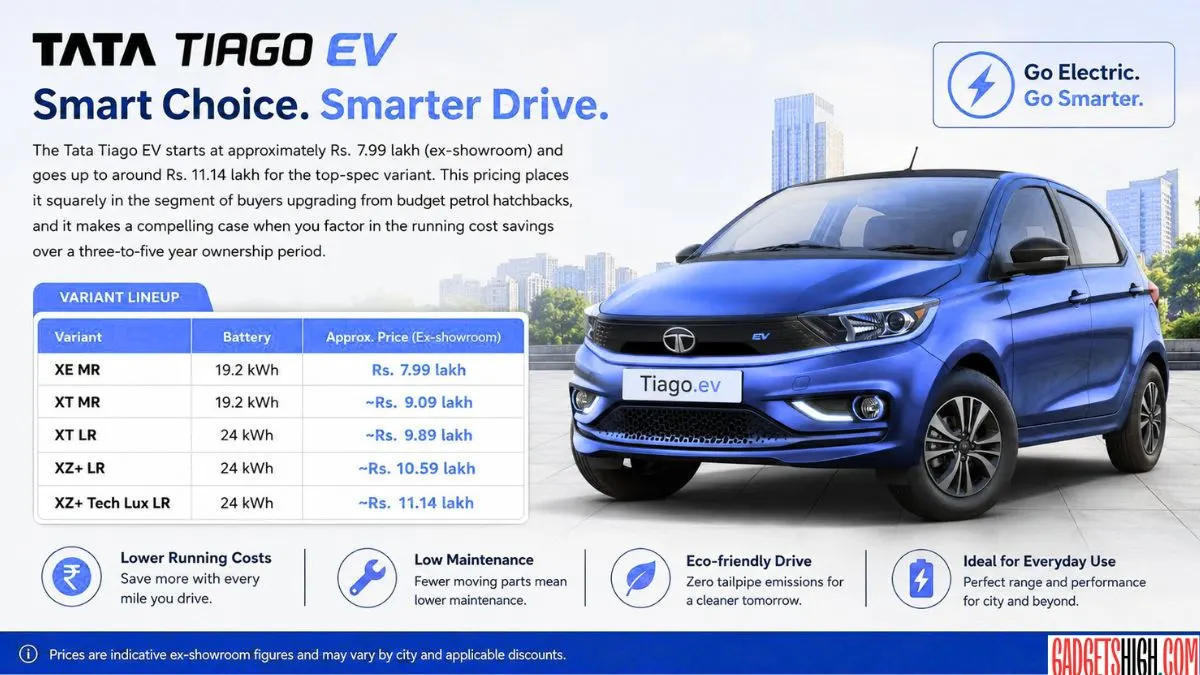
The Tata Tiago EV starts at approximately Rs. 7.99 lakh (ex-showroom) and goes up to around Rs. 11.14 lakh for the top-spec variant. This pricing places it squarely in the segment of buyers upgrading from budget petrol hatchbacks, and it makes a compelling case when you factor in the running cost savings over a three-to-five year ownership period.
Here is the variant lineup:
| Variant | Battery | Approx. Price |
|---|---|---|
| XE MR | 19.2 kWh | Rs. 7.99 lakh |
| XT MR | 19.2 kWh | ~Rs. 9.09 lakh |
| XT LR | 24 kWh | ~Rs. 9.89 lakh |
| XZ+ LR | 24 kWh | ~Rs. 10.59 lakh |
| XZ+ Tech Lux LR | 24 kWh | ~Rs. 11.14 lakh |
Prices are indicative ex-showroom figures and may vary by city and applicable discounts.
The most sensible purchase for most buyers is the XT LR or XZ+ LR — the larger 24 kWh battery makes the real-world range comfortable enough for the vast majority of Indian driving patterns, and the price jump is justifiable.
Tata Tiago EV Battery Range Full Details
One of the most important decisions when buying the Tiago EV is choosing between the two battery packs. Here is an honest look at both.
19.2 kWh Battery Pack
The smaller battery delivers a claimed MIDC range of around 250 kilometers. In real-world mixed driving—which includes stop-and-go city traffic, some highway stretches, and the air conditioning running in Indian summer temperatures—expect somewhere between 180 to 220 kilometers on a full charge.
[Read more about TATA Avinya EV: Price, Range & Launch Date in India 2026.]
For someone who drives 40 to 50 kilometres a day in the city and charges overnight at home, this battery is more than sufficient. You would charge the car once every four or five days and barely think about it.
[Read more about Electric Scooter Under 50000 List in 2026 | Top 10 EV Scooters.]
However, if you have a longer daily commute, live on the outskirts of a city with limited fast chargers nearby, or occasionally need to take intercity runs, the smaller pack starts showing its limitations.
24 kWh Battery Pack
This is where the Tiago EV gets considerably more capable. The claimed MIDC range is approximately 315 kilometers, and in realistic mixed driving conditions, most owners report getting between 220 to 280 kilometers before needing a charge.
That 280-kilometer practical ceiling is what makes the Tiago EV workable not just for city commuting but also for weekend trips between nearby towns or district-level intercity runs. For a large part of India’s urban and semi-urban population, this range comfortably covers a week’s driving on a single charge.
What Actually Affects Your Range
A few factors worth keeping in mind:
- Air conditioning can reduce range by 15 to 25 percent in peak summer, which matters a great deal in cities like Nagpur, Jaipur, or Delhi during May and June.
- Highway driving at 80 to 100 km/h drains the battery faster than city driving, where regenerative braking recovers a meaningful amount of energy.
- Eco mode vs Sport mode can shift your real-world range noticeably—Eco mode is genuinely useful and worth using on longer runs.
- Battery temperature in extremely cold regions can slightly reduce effective capacity, though this is less of a concern across most of India.
Charging: What You Need to Know
Charging infrastructure anxiety is the number one reason many buyers hesitate before buying an EV. Here is the practical reality for Tata Tiago EV owners.
Home Charging (Standard AC Charger)
This is how the vast majority of Tiago EV owners charge their car — plugging in at home overnight using the standard charger.
- Charging time (10% to 100%): Approximately 6 to 8 hours
- A standard 15-amp household socket works with the included charger
- Most owners plug in when they get home in the evening and wake up to a fully charged car
If you live in a housing society or apartment building without a dedicated parking spot, this requires a bit of planning. But for anyone with home parking, this becomes completely routine within a week.
DC Fast Charging (Public Chargers)
The Tiago EV supports DC fast charging, which is a significant practical advantage over cheaper EVs that do not.
- Charging time (10% to 80%): Approximately 58 minutes
- DC fast chargers are available at Tata Motors’ Ziptron charging network, third-party networks like Statiq, ChargeZone, and Ather Grid, as well as petrol pumps along major highways
Fast charging from near-empty to 80 percent in under an hour is genuinely useful when you are on a road trip and need a quick top-up during a lunch break. It is not as fast as filling up at a petrol pump, but it is practical enough that range anxiety on planned routes becomes manageable.
Features and Technology: What You Get
For a car that starts under Rs. 8 lakh, the Tiago EV is reasonably well-equipped. Here is a clear-eyed look at what the feature list actually delivers.
Infotainment and Connectivity
The 7-inch touchscreen infotainment system is the centrepiece of the cabin. It supports both Android Auto and Apple CarPlay, which means your phone’s navigation, music, and messaging apps integrate directly into the screen. This works well in practice and makes the relatively modest screen size feel more capable than it looks.
[Read more about Tata Altroz 2026– Price, Features, CNG Mileage in India.]
The Connected Car Technology through the Tata Motors app allows remote monitoring of battery status, charging status, location, and climate pre-conditioning. For buyers who are new to EVs, being able to check the battery level from your phone before heading out is a genuinely reassuring feature.
Comfort Features
- Automatic Climate Control — a meaningful upgrade over manual AC in heavy traffic
- Push Button Start — standard on mid-spec and above
- Cruise Control — useful for highway drives and surprisingly rare at this price point
- Digital Instrument Cluster — gives the cabin a more modern feel and displays drive mode, range, and regenerative braking information clearly
Drive Modes
The Tiago EV offers multiple drive modes including City, Eco, and Sport. This is not just a marketing feature — Eco mode genuinely extends range on longer journeys, while Sport mode makes city overtaking and merging feel noticeably brisker. Having the option matters.
Safety: How Does It Perform?
Tata Motors has built a strong reputation for safety in the Indian market, and the Tata Tiago EV carries that forward.
Standard safety equipment across variants includes:
- Dual front airbags
- ABS with EBD (Anti-lock Braking System with Electronic Brakeforce Distribution)
- Corner Stability Control
- Reverse Parking Camera
- Tyre Pressure Monitoring System (TPMS)
- Hill Hold Assist (on select variants)
The underlying platform is built on Tata’s Ziptron EV technology, which includes a battery management system designed to handle Indian driving conditions — including the heat, humidity, and infrastructure gaps that come with real-world use on Indian roads.
While the Tata Tiago EV has not been independently crash-tested by NCAP with updated protocols specifically for the 2026 version, Tata’s broader safety track record across its lineup adds credibility.
Running Cost: The Real Financial Case
This is where the Tiago EV makes its strongest argument, and it is worth doing the actual numbers rather than relying on vague claims.
Cost Per Kilometre
Assume an average electricity tariff of Rs. 8 per unit (kWh), which is a reasonable middle-ground figure across most Indian cities:
- The 24 kWh battery pack costs approximately Rs. 192 to fully charge
- At a realistic 250-kilometre real-world range, that works out to roughly Rs. 0.77 per kilometre
- Even at a slightly conservative estimate of 220 kilometres of real-world range, you are looking at approximately Rs. 0.87 per kilometre
Compare this with a typical petrol hatchback:
- Fuel efficiency: 18 to 22 km/litre in mixed city driving
- Petrol price at Rs. 105 per litre: Rs. 4.77 to Rs. 5.83 per kilometre
That is a savings of roughly Rs. 4 per kilometre. For someone driving 50 kilometres a day, that is a saving of Rs. 200 every single day — or approximately Rs. 6,000 per month, or Rs. 72,000 per year.
Over a five-year ownership period, the running cost savings alone can amount to Rs. 3.5 lakh or more, which meaningfully offsets the higher initial purchase price compared to a petrol equivalent.
Maintenance Savings
EVs have far fewer moving parts than internal combustion engine vehicles. There is no engine oil, no spark plugs, no timing belts, and no clutch to replace. Scheduled maintenance for the Tata Tiago EV is simpler and considerably cheaper than for a comparable petrol car.
Tata Motors’ service network is one of the largest in India, which means getting the car serviced — whether it is a routine check or a warranty-related repair — is not the ordeal it can be with some other EV brands that have thinner dealer footprints.

Where the Tiago EV Shines
Affordability without compromise on usability. At under Rs. 8 lakh for the entry variant, this is genuinely the most accessible route into EV ownership in India. You are not being asked to compromise on a stripped-down, feature-bare vehicle.
Daily commuting range is genuinely sufficient. For most city and semi-urban dwellers, the 24 kWh pack’s real-world range of 220 to 280 kilometres is more than enough for a week’s driving between charges.
Running costs are transformatively low. The financial case is straightforward and significant for daily commuters who currently spend heavily on petrol.
Tata’s after-sales network. One of the most underrated advantages — you can get the car serviced in Tier 2 and Tier 3 cities without hunting for a specialised EV mechanic.
Fast charging support. This is not a given at this price point, and its inclusion meaningfully improves the car’s practicality for occasional longer trips.
Where the Tiago EV Falls Short
Highway range anxiety is real. While city range is solid, high-speed highway driving reduces range noticeably. If you frequently drive 250+ kilometre highway stretches between charges, you will need to plan your charging stops, and the charging network on smaller highways outside major corridors is still patchy.
Boot space is limited. The Tiago is a small hatchback, and the boot space reflects that. Large families or buyers who regularly carry substantial luggage will find it restrictive.
The base 19.2 kWh variant is a compromise. While it works fine for very modest daily use, most buyers are better served by the 24 kWh variants. The price difference is worth paying.
Long road trips require planning. Unlike a petrol car where you find a pump everywhere, longer highway routes still require some advance research into fast charger locations. This is getting better, but it has not been entirely solved yet.
Tata Tiago EV Top Competitors
The Tata Tiago EV does not exist in a vacuum. Here is how it stacks up against its closest competitors in 2026.
MG Comet EV — More stylish and urban, but very limited range and lacks the practicality for anything beyond hyper-local city use. Lower price but also lower capability.
Citroën eC3 — Similar positioning, decent range, and a distinctive design aesthetic. Worth considering, though Tata’s service network advantage is hard to match in smaller cities.
Tata Tigor EV— A sedan body gives slightly more boot space, but the Tiago EV generally offers better value for city buyers who prioritise maneuverability and running costs.
Tata Punch EV — A step up in size, features, and price. If your budget stretches to Rs. 12 to 14 lakh and you want more road presence and boot space, the Punch EV is worth considering. But for buyers firmly in the under-Rs. 11-lakh bracket, the Tiago EV is the stronger financial case.
Who Should Buy the Tata Tiago EV in 2026?
The Tata Tiago EV is not for everyone, but for the right buyer profile, it is arguably one of the best financial decisions you can make in this segment.
You are an ideal Tiago EV buyer if:
- Your daily driving is between 30 and 80 kilometres
- You have access to home charging (even a standard 15-amp socket)
- You want to meaningfully reduce monthly fuel and maintenance spending
- You are buying your first EV and want something reliable and well-supported
- You primarily drive in the city or on familiar intercity routes with decent charging infrastructure
- You want modern features—touchscreen, Apple CarPlay, connected tech—at an accessible price
You might want to look elsewhere if:
- You regularly take long highway trips of 300+ kilometres without planned stops
- You need substantial boot space for regular cargo or family travel
- You live in a housing situation with no practical charging access at home or work
Overall Rating: 8.5 / 10
Frequently Asked Questions
Q: What is the real-world range of the Tata Tiago EV?
In mixed city and light highway driving, most owners report 220 to 280 kilometres from the 24 kWh variant. The 19.2 kWh variant delivers around 180 to 220 kilometres in similar conditions.
Q: What is the starting price of the Tata Tiago EV in 2026?
The starting ex-showroom price is approximately Rs. 7.99 lakh for the base XE MR variant.
Q: Does the Tiago EV support DC fast charging?
Yes. The Tiago EV supports DC fast charging and can charge from 10 to 80 percent in approximately 58 minutes.
Q: Is the Tiago EV good for highway driving?
It is manageable for moderate highway use, but high-speed highway driving reduces range noticeably. Long highway journeys require advance planning around charging station locations.
Q: How much does it cost to charge the Tata Tiago EV at home?
At an average electricity rate of Rs. 8 per unit, a full charge of the 24 kWh battery costs approximately Rs. 192, which typically provides 220 to 280 kilometres of real-world range.
Q: How long does home charging take?
Using a standard 15-amp home charger, the car takes approximately 6 to 8 hours for a full charge. Most owners simply plug in overnight.
Q: Is the Tiago EV a good first EV to buy?
Yes — it is one of the most recommended first EVs for Indian buyers due to its accessible price, reliable Tata service network, practical range for daily use, and straightforward charging setup.
Final Verdict
The Tata Tiago EV in 2026 remains one of the most compelling arguments for EV adoption in India not because it is the flashiest or most capable electric car you can buy, but because it is the most sensible one at its price point.
It does the core job extremely well: it gets you through your daily routine without burning fuel, it keeps running costs low, it is backed by a service network that actually exists in your city, and it comes equipped with enough modern features that you do not feel like you are sacrificing comfort or convenience in the name of going electric.
The financial case for buyers who drive 40 to 70 kilometres daily is hard to argue with. The running cost savings alone can recover a large portion of the price premium over a comparable petrol hatchback within three to four years, and the lower maintenance costs add further to the long-term value.
Is it perfect? No. The limited boot space, the range constraints on high-speed highways, and the need for home charging infrastructure mean it is not the right car for every buyer. But for the large, clearly defined audience it was designed for first-time EV buyers, daily city commuters, and practically minded families the Tata Tiago EV is as good a value proposition as Indian buyers are likely to find at this price in 2026.
About Rajendra Parmar
Rajendra Parmar is the founder and editor of GadgetsHigh, a technology-focused platform covering the latest updates, reviews, comparisons, and buying guides for smartphones, smart TVs, laptops, smartwatches, gadgets, and electric vehicles (EVs).
With a strong passion for technology and consumer electronics, Rajendra regularly researches and publishes content on emerging tech trends, new product launches, EV developments, and in-depth gadget comparisons. His goal is to provide accurate, practical, and easy-to-understand information that helps readers make informed purchasing decisions.
At Gadgets High, he focuses on delivering reliable coverage of:
- 📱 Smartphones → — Budget to mid-range, best phones for every pocket
- 💻 Laptops → — Student laptops, office workhorses, and light gaming machines
- 📺 Smart TVs → — Tested for real picture quality and smart OS performance
- ⌚ Smartwatches → — We separate real features from marketing gimmicks
- 🎧 Smart Gadgets → — TWS earbuds and neckbands across all price points
- 🛠️ AI & Online Tools → Helpful AI tools, productivity apps, and digital solutions for everyday users
- ⚡ Auto & EVs → Electric scooters, bikes, and cars explained simply.
Rajendra founded Gadgets High with the vision of making technology information accessible to everyone through well-researched, reader-friendly content.
Social Connect with Rajendra Parmar
YouTube | LinkedIn | Facebook |
Contact: Email: Raj.parmar3399@gmail.com
The information published on Gadgets High is researched from official sources, product announcements, industry updates, and hands-on analysis wherever applicable. Readers are encouraged to verify product specifications and pricing from official websites before making purchase decisions.
